AI Search Impact on Business: What the Click Data Shows and What to Do
AI search is cutting clicks on informational queries while buyers do more of their research inside AI answers. This post covers the click data, how each AI surface picks sources, robots.txt choices, a GA4 measurement checklist, and what not to spend on.
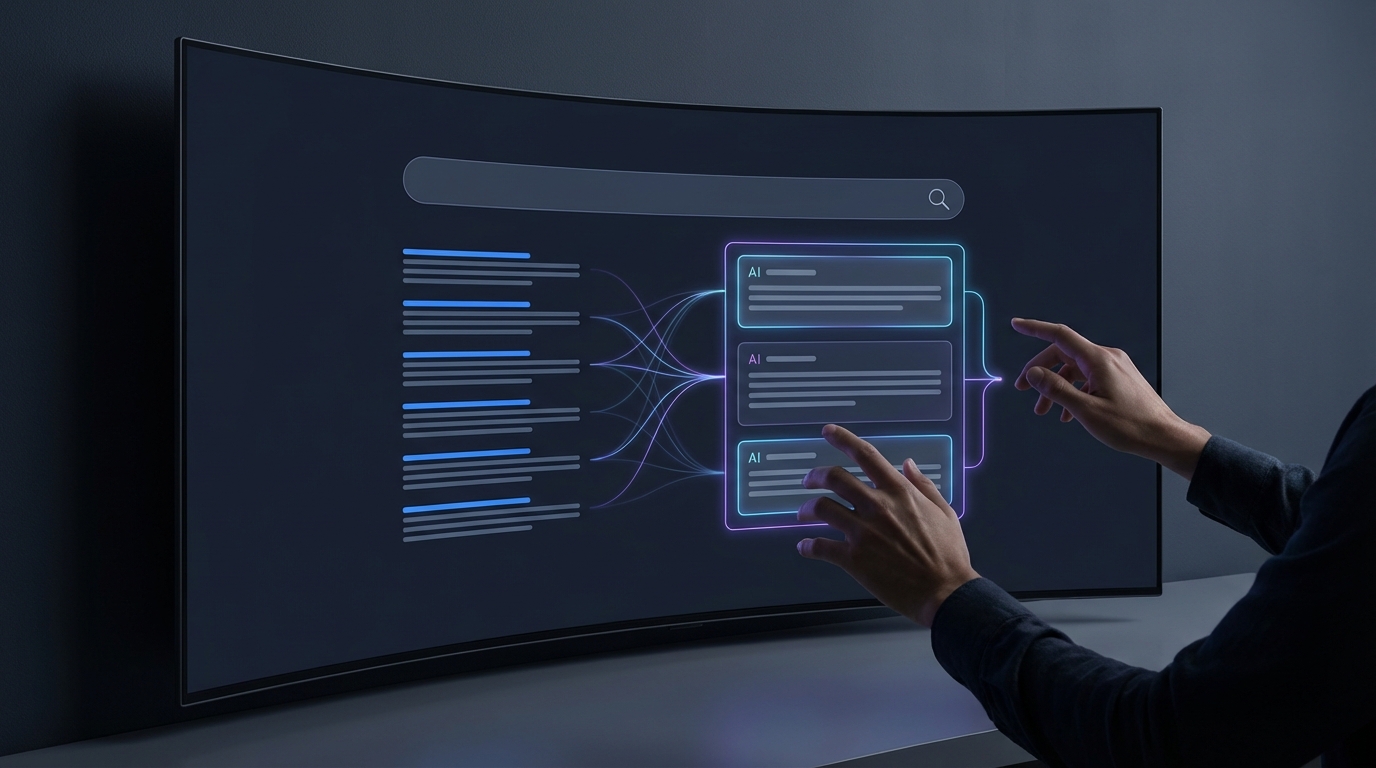
AI search is cutting clicks, not research. When Google shows an AI Overview, the top organic result’s desktop click-through rate runs about 58% below what Ahrefs’ model expected without one. And 68% of US Google searches ended with no click in early 2026. Buyers still research vendors. More of that research now ends inside the answer, so the goal moves from ranking to being the cited source.
Below: the data on AI search impact on business, how each AI surface picks sources, what to change, and how to measure it.
What the click data says about AI search impact on business
Pew Research Center tracked the browsing of 900 US adults in March 2025. Users who saw an AI summary clicked a traditional result on 8% of visits, against 15% for users who saw none. Links inside the summary got a click on 1% of visits. I found no newer Pew edition.
Ahrefs’ February 2026 update compared 300,000 keywords using aggregated Search Console data from December 2023 and December 2025. Where an AI Overview appeared, the top result’s average desktop click-through rate was 58% below a modeled counterfactual: the rate Ahrefs projected from similar keywords without an AI Overview. Its April 2025 study found 34.5%. The gap was about 51% at position two and 19% at position ten. These are desktop CTR estimates, not total clicks, and a correlation, not proof of cause.
The broadest number comes from SparkToro, using Similarweb’s clickstream panel. From January to April 2026, 68.01% of US Google searches in browsers ended with no click, against 60.45% in 2024 on a different panel. Publishers feel it too. Chartbeat data in the Reuters Institute’s 2026 report shows Google organic search traffic fell 33% across 2,576 sites worldwide and 38% across the 797 US sites from November 2024 to November 2025. The report says it is unclear how much is due to AI Overviews.
Google disputes the aggregate story. Head of Search Liz Reid wrote in August 2025 that total organic click volume was “relatively stable year-over-year,” with slightly more “quality clicks,” meaning visits where the user does not quickly click back. The post included no underlying data. My read: total clicks can hold steady while clicks on informational queries, the kind most B2B content targets, fall hard.
How is AI search changing SEO?
Google’s guide to generative AI features in Search explains the mechanism. AI Overviews and AI Mode use retrieval-augmented generation: core ranking systems retrieve pages from the Search index, and the model writes an answer grounded in them. They also use query fan-out, firing several related searches at once. It is the same RAG pattern a company uses on its own documents, applied to the open web.
Two things follow. The answer often settles the question on the results page, so fewer people click. And because citations come from many sub-queries, the top-ranked page can be left out.
Seer Interactive’s 2026 study covers 53 brands, 5.47 million queries, and 2.43 billion organic impressions from January 2025 to February 2026. On informational queries, per million impressions, Seer counted about 33,500 clicks with no AI Overview, 20,743 when the brand was cited, and 9,445 when it was not. A citation is worth 120% more clicks than no citation, but still 38% fewer than a page with no AI Overview. Seer says it cannot claim causation, because higher-authority brands are also more likely to be cited.
Lower CTR on AI Overview queries is not the same as a decline that keeps going. In Seer’s data, organic CTR on those queries fell through 2025 to 1.31% in December, then rebounded to 2.36% by February 2026. Seer warns against extending the 2025 decline forward, or forecasting growth from two months.
Exposure depends on query type. AI Overviews appeared on 36% of informational queries, 8% of commercial queries, and 5% of transactional ones. Among informational queries, comparisons triggered one 95.4% of the time and question-format queries 85.9%.
Decision rule: if most of your organic traffic comes from “what is,” “how to,” and “X vs Y” pages, assume an AI Overview sits above them and plan for citation, not rank.
Why it matters more for companies buying and selling AI
B2B buyers moved first. Forrester’s Buyers’ Journey Survey, 2025 found 94% of business buyers use AI in their buying process, up from 89% a year earlier. Twice as many buyers named generative AI or conversational search as a more meaningful source than any other, ahead of vendor websites, product experts, and sales. Forrester’s public post does not give the sample size.
My read: buyers of AI services sit at the far end of that curve. A CFO comparing agent vendors, or an ops lead pricing a first deployment, likely has an assistant open already. If the answer cites a competitor’s pricing page and a forum thread, your site never makes the shortlist. For the adoption and spend picture, see the state of AI agents in 2026.
Do not overreact to traffic. Ahrefs’ traffic benchmark, across 115,254 sites using its analytics tool, shows AI assistants sent 0.43% of all visits in September 2026. Google sent 23.96%. AI matters mostly as an influence on the decision, so measurement has to cover citations and mentions, not only clicks.
A one-hour test: list the ten questions buyers ask before a first call, such as cost, timeline, security, and what to ask a vendor. Ask each in ChatGPT, Gemini, Perplexity, and Copilot. Whoever gets cited is your real competition in AI search.
The AI search surfaces, side by side
Each surface picks sources differently and needs its own measurement path.
| Surface | How it picks sources | How to appear | How to measure |
|---|---|---|---|
| Google AI Overviews | Search index, RAG plus fan-out. Shown only when Google judges it adds value. | Indexed and snippet-eligible. Search generative AI control set to include. | Search Console Generative AI performance report. GA4 Organic Search. |
| Google AI Mode | Same index, more fan-out for comparisons and follow-ups. | Same, plus pages for the next questions buyers ask. | Same as AI Overviews. |
| Gemini app | Grounding with Google Search. | Do not block Google-Extended. | GA4 AI Assistant channel. |
| ChatGPT search | OpenAI’s crawler, OAI-SearchBot. | Allow OAI-SearchBot in robots.txt and at the CDN. | GA4 AI Assistant channel. |
| Perplexity | Its own crawler, PerplexityBot. | Allow PerplexityBot. | Custom GA4 channel group. |
| Microsoft Copilot | Bing index. | Verify in Bing Webmaster Tools. Stay indexed in Bing. | Bing Webmaster Tools AI Performance report. GA4 AI Assistant channel. |
| Claude | Claude-SearchBot, plus Claude-User for user-requested fetches. | Allow both. | Custom GA4 channel group. |
One gap to know. The GA4 default channel definitions count clicks from AI Overviews and AI Mode as Organic Search, mixed with classic results. Search Console’s Generative AI performance report shows impressions, not clicks. You see where Google showed you, not who clicked.
How does a B2B company get cited in AI answers?
Google’s guide names what matters most: “non-commodity content” that goes past common knowledge. An answer built from ten pages has no reason to cite an eleventh that says the same thing. It needs the page with the number nobody else has.
Four kinds of pages fit that bar for companies buying or building AI:
- Original numbers. Cost ranges, timelines, benchmarks, or survey results, with the method and sample stated.
- Direct answers up front. Answer the page’s question in the first two or three sentences. Fan-out retrieves passages, and a clear passage is easier to ground on.
- Comparison pages with criteria. With comparison queries triggering AI Overviews 95% of the time, explicit criteria and trade-offs give the model something specific to cite.
- Pages that state their limits. Vague sources invite hallucination. A page that says when its advice does not apply is easier to quote accurately.
On schema, Google’s guide says structured data is not required for generative AI features, though it still helps with rich results. Use Article, Organization, and FAQ markup where true, and stop there.
The failure mode to catch first is JavaScript-only rendering. Google’s guide says SEO on JavaScript framework sites is “generally more complex,” and I would not assume every AI crawler renders JavaScript as well as Googlebot. Fetch your key pages with curl. If the main text is not in the response, fix that before writing anything new.
Robots.txt choices for GPTBot, Google-Extended, and ClaudeBot
Do not treat “AI bots” as one group. The major companies split training from search, and blocking the wrong bot costs visibility.
OpenAI’s crawler documentation says each setting is independent. Sites that block OAI-SearchBot “will not be shown in ChatGPT search answers,” though they can still appear as navigational links. GPTBot crawls content that may train OpenAI’s models. ChatGPT-User fetches pages when a user asks, and robots.txt may not apply to it.
Anthropic’s crawler article lists ClaudeBot for training, Claude-SearchBot for search indexing, and Claude-User for user questions. Anthropic says all three honor robots.txt.
Google-Extended governs Gemini model training and grounding in the Gemini app and Vertex AI. It does not affect Google Search. To leave AI Overviews and AI Mode, you use the Search generative AI control in Search Console, rolled out to all sites on August 31, 2026. Excluding your site removes your links from those features within a few days. It does not affect training.
| Setting | What blocking does | My default for a B2B site |
|---|---|---|
| OAI-SearchBot | Removes you from ChatGPT search answers | Allow |
| GPTBot | Opts out of OpenAI model training | Policy call |
| Claude-SearchBot | May reduce visibility in Claude search | Allow |
| ClaudeBot | Opts out of Anthropic model training | Policy call |
| Google-Extended | Opts out of Gemini training and Gemini app grounding | Allow unless training is a hard no |
| Search generative AI control | Removes you from AI Overviews and AI Mode | Include |
A robots.txt that allows search but opts out of OpenAI and Anthropic training:
User-agent: OAI-SearchBot
Allow: /

User-agent: Claude-SearchBot
Allow: /

User-agent: PerplexityBot
Allow: /

User-agent: GPTBot
Disallow: /

User-agent: ClaudeBot
Disallow: /
Decision rule: if your buyers research with AI, allow every search and retrieval bot, and decide training as a separate policy question. Then confirm your CDN is not blocking what robots.txt allows.
How do you measure AI search traffic in GA4? A setup checklist
GA4’s default channel group now has an AI Assistant channel for visits from “sources like ChatGPT, Gemini, Deepseek, Copilot, or Grok,” with the medium set to “ai-assistant.” Claude and Perplexity are not named, and default groups cannot be edited.
- Confirm the native channel. In Traffic acquisition, find the AI Assistant row under Session default channel group.
- Build a custom channel group. Copy the default group and edit its AI Assistant channel to also match source claude.ai or perplexity.ai. Channel groups use the first rule that matches, so if you add a separate “AI assistants (all)” channel instead, place it above both the native AI Assistant channel and Referral.
- Mark key events. Demo requests, contact forms, and pricing page views. Compare key-event rate by channel, not sessions.
- Add a self-reported source field. Put “How did you hear about us?” on the demo form, with “ChatGPT or another AI assistant” as an option. Buyers who learn your name in an answer and type it in later show up as Direct or branded search.
- Export the Search Console Generative AI performance report monthly. It counts links shown, not reading. Rising AI impressions with falling clicks is a pattern to investigate, page by page.
- Verify Bing Webmaster Tools. Its AI Performance report shows Copilot citation counts and grounding queries.
- Count crawler hits in server logs. Track OAI-SearchBot, Claude-SearchBot, PerplexityBot, and Googlebot by URL. Zero search-bot hits on a key page in 30 days is a trigger to check, since crawling is not guaranteed. Check discovery (links, sitemap), crawl demand, log coverage, and access (robots.txt, CDN, firewall) separately.
- Run a monthly prompt panel. Ask your ten buyer questions in four assistants and log who gets cited. Answers vary, so track the trend.
Worked example: sizing the cited vs. uncited gap
This is hypothetical. It applies Seer’s informational-query averages, which compare separate cohorts of queries, not the same company before and after earning a citation. Say a B2B software company gets 200,000 monthly Google impressions on informational queries.
- At the no-AI-Overview cohort rate: 200,000 × 33,500 per million = 6,700 clicks.
- At the not-cited cohort rate: 200,000 × 9,445 per million = 1,889 clicks.
- At the cited cohort rate: 200,000 × 20,743 per million = 4,149 clicks.
The difference between the cited and not-cited rates is 2,260 clicks a month. At a hypothetical 1% visit-to-demo rate, that difference equals about 23 demo requests. At 0.5%, about 11. This is an illustrative difference between cohort averages, not a forecast of what one citation would add.
Now the sensitivity check. Seer notes one account makes up 47% of the not-cited impressions at a 0.20% CTR. Without it, the not-cited rate is about 1.61%, which gives 3,220 clicks and a difference of 929, about 9 demo requests at 1%. So the illustrative difference is about 930 to 2,260 clicks a month, depending on the baseline. Your real effect could fall outside it, because Seer notes higher-authority brands are more likely to be cited.
My recommendation: use the range to size the bet, not to promise a payoff. If a research-backed page earns no AI impressions in Search Console after 90 days, rewrite it or stop.
What not to waste money on
Google’s guide lists tactics you can ignore for Google Search. Others fail on their own terms.
- llms.txt for Google. Google lists “LLMS.txt files and other ‘special’ markup” as unnecessary because Google Search does not use them. llms.txt is a proposal, not a standard.
- Chunking and rewriting for AI. Google says its systems understand synonyms and multi-topic pages, so splitting content into tiny pieces does not help.
- A page for every fan-out query. Google warns that making separate content for every search variation, mainly to manipulate AI responses, violates its scaled content abuse policy.
- Seeded or bought mentions. Google says inauthentic mentions help less than they seem, because its spam systems also feed its AI features.
- Precision AI rank tracking. Prompt-sampling tools show direction. Answers vary by user and run, so I would not pay for decimal-point “visibility scores.”
- Panic cuts to paid search. In Seer’s data, paid CTR on AI Overview queries held in a consistent 13% to 16% range through 2025 and into 2026.
Bottom Line
AI search moves the buying decision upstream of your website. Informational queries with AI Overviews get fewer clicks, and buyers of AI research inside answers.
Be the page the answer cites. Allow the search bots, decide training separately, and measure citations as well as clicks.
Start this week with the ten buyer questions and the GA4 custom channel group. Scoping your first AI agent? Same discipline: one metric, measured honestly.
FAQ
Does blocking GPTBot remove my site from ChatGPT?
No. GPTBot (training) and OAI-SearchBot (search) are separate settings. If you allow both, OpenAI may use one crawl for both purposes. Robots.txt changes take about 24 hours to reach ChatGPT search.
Can I opt out of AI Overviews but stay in Google Search?
Yes. Choose exclude in the Search generative AI control in Search Console. It also covers generative AI features in Google Discover, and a child property such as a /blog/ path can set its own value. Snippet controls like nosnippet also limit AI use, but they cut your classic snippets too.
Is AI assistant traffic worth more than Google traffic?
There is no clean public answer for B2B. Google claims clicks from AI Overview pages are higher quality. Compare key-event rates for your AI Assistant channel and Organic Search over 90 days before believing anyone’s claim, including mine.
Does Google AI Mode matter yet?
Google said at I/O 2026 that AI Mode passed 1 billion monthly users, per SparkToro. But in Similarweb’s US browser panel, only 0.34% of Google searches went to AI Mode from January to April 2026. Watch it, but do not rebuild your plan around it yet.
Three Ways to Work With TMA
Need an agent built? We deploy production AI agents in your infrastructure. Working pilot. Real data. Measurable ROI. → Schedule Demo
Want to co-build a product? We’re not a dev agency. We’re co-builders. Shared cost. Shared upside. → Partner with Us
Want to join the Guild? Ship pilots, earn bounties, share profit. Community + equity + path to exit. → Become an AI Architect
Need this implemented?
We design and deploy enterprise AI agents in your environment with measurable ROI and production guardrails.
About the Author

Chase Dillingham
Founder & CEO, TrainMyAgent
Chase Dillingham is the founder and CEO of TrainMyAgent. He spent 15+ years as an enterprise architect deploying production systems. Now he builds AI agent platforms that deliver measurable ROI.
Connect with Chase Dillingham on LinkedIn